A 10-week live online course

The Architecture
of 64

Exploring the ancient foundations of Human Design & the Gene Keys through the I Ching.

with Fabrice Boulenger

4 of 12 places available

Starts November 11, 2026 · Taught in English

Wednesdays 18:00–19:30 CET · Sundays 18:00–19:00 CET

See the live schedule ↓
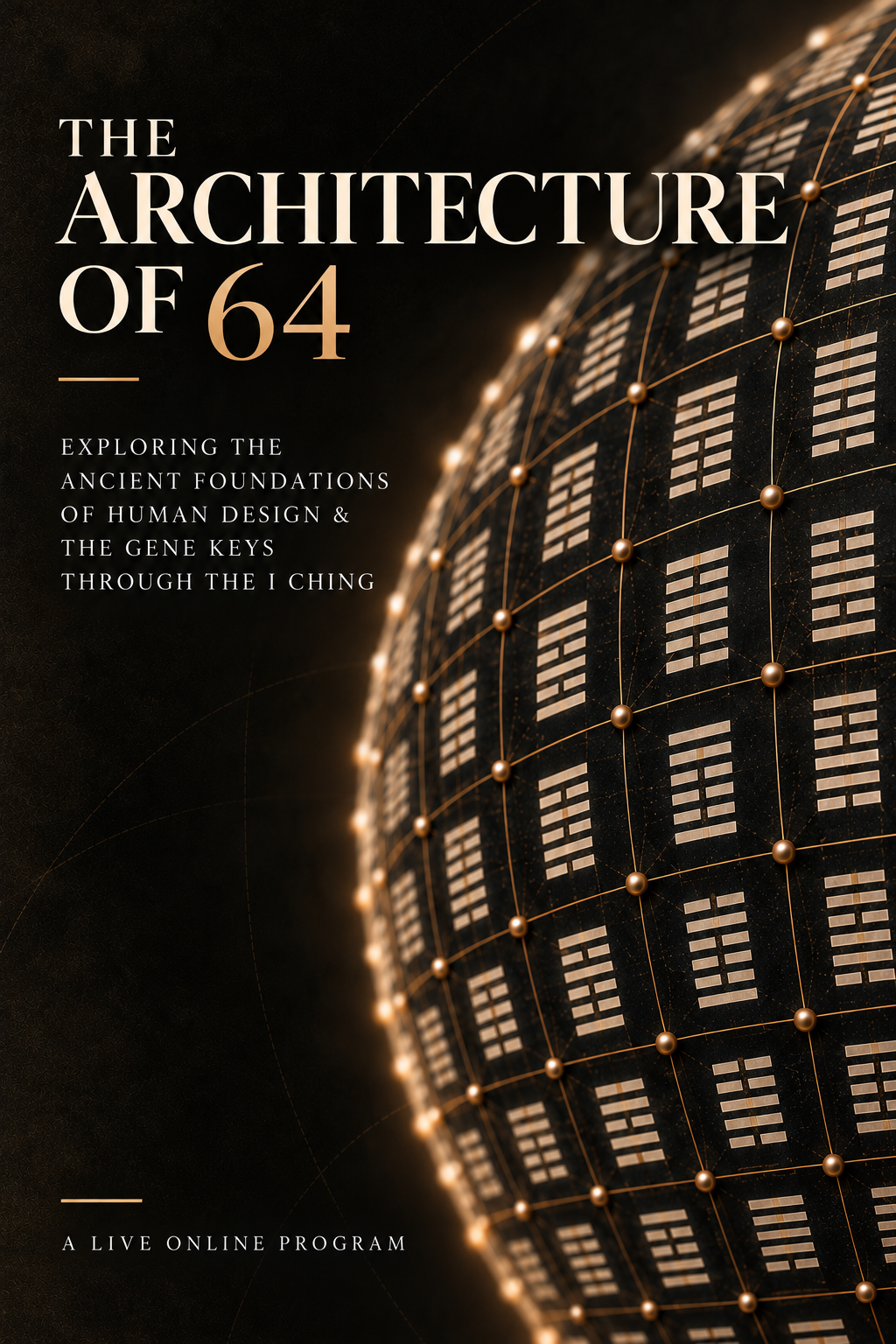
The Architecture of 64 event cover: a golden network of hexagrams on a dark globe.

Why study this?

The patterns behind your Gates and Gene Keys

What becomes visible when you study the 64 Gene Keys together?

Most of us meet the Gene Keys one at a time, through the numbers in our profile and their descriptions. This course explores the connections between them, beginning with the I Ching.

Each hexagram is made from two trigrams, each containing three yin or yang lines. Eight trigrams combine in 64 ways. Learning to recognise these patterns gives you another way into a Gene Key: through the family it belongs to, the figures it pairs with and the changes within its six lines.

For example, all seven Spleen Gates in Human Design share the same lower trigram, Wind/Wood. We’ll explore how that common pattern takes different forms, then bring these comparisons to the Gates and Gene Keys in your own profile.

What you’ll learn to do

Course structure

What we’ll explore

  1. 01

    How six lines form 64 hexagrams

    We begin with yin and yang, then build the trigrams and hexagrams step by step. We’ll introduce the maps used throughout the course and distinguish the classical I Ching from its later Human Design and Gene Keys interpretations. We’ll also open the question of why 64 appears in genetics and in Indian traditions such as the 64 Yoginīs and the 64 arts.

  2. 02-09

    A session for each trigram family

    • Heaven
    • Earth
    • Thunder
    • Wind / Wood
    • Water
    • Fire
    • Mountain
    • Lake

    Each session follows one of the eight families. We begin with the trigram paired with itself, such as Water over Water, then see what changes when the upper trigram is replaced by each of the other seven.

    Using the interactive app, we’ll compare the family’s eight hexagrams, their Gene Keys themes and their positions in the Human Design chart. We’ll work with these relationships as prompts for contemplation, drawing on the Gates and Gene Keys you’re studying. Some connections are clearer than others, and we’ll make room to examine that.

  3. 10

    From your profile to the whole

    We’ll bring the families and maps together, then explore the question at the heart of the course: how can each Gene Key express something distinct while belonging to one whole? Drawing on Non-Dual Tantra, we’ll compare inward contemplation with recognising that same wholeness within everyday experience.

The eight trigram sessions are listed by theme; their teaching order will be confirmed.

Across the ten sessions

The relationships we’ll investigate

How one Gene Key relates to another
18
17
A complementary pair

What happens when every line changes from yin to yang or vice versa, when a hexagram is turned upside down, or when just one line changes? We’ll use these simple operations to explore Programming Partners and other relationships. The pair 17 and 18, for example, is linked by both reversal and the exchange of yin and yang.

What a hexagram’s inner lines reveal
1
2
63
64

A hexagram’s inner lines can form another hexagram. Repeating this process leads to just four figures: 1, 2, 63 and 64. We’ll learn this method, called nuclear reduction, and explore the difference between the two stable poles and the pair that keeps moving between completion and a new beginning.

Trigram families in the Human Design chart

The eight families occupy consecutive sections of the Rave Mandala, the wheel of 64 Gates. Some also gather strongly in particular centres: all seven Spleen Gates belong to Wind/Wood, while seven Throat Gates belong to Earth. We’ll explore what these patterns suggest about the Gates, and look at recurring connections between centres.

Seeing the same 64 through different maps

The King Wen sequence, the eight-by-eight trigram grid, the Human Design Mandala and the modern Yi-globe arrange the same 64 figures differently. The app lets us follow a hexagram through these maps and see its neighbours. We’ll also explore the connections formed by changing one line, starting from any Gene Key.

Why 64 hexagrams and 64 codons?

Six yin/yang lines produce 64 hexagrams; three positions with four possible bases produce 64 genetic codons. We’ll explore the history of this comparison and the Codon Rings used in the Gene Keys. The Ring of Matter, for example, groups 18, 46, 48 and 57, all in the Wind/Wood family.

We’ll keep the mathematics and biology distinct from the meanings proposed in the Gene Keys.

Three approaches to contemplation

Path to Core: follow the inner lines of a hexagram to see which patterns remain.

Path to Source: turn inward and contemplate what remains as distinctions are gradually released.

Path of Recognition: explore whether a sense of wholeness can be present while the differences of everyday life remain.

These approaches draw the geometry into a wider contemplation of consciousness, informed by Non-Dual Tantra. We’ll explore them as connections between traditions.

Included in the course

For the curious

A closer look at Gene Key 18
18

Can something be perfect and still changing?

Gene Key 18 moves through Judgment, Integrity and Perfection. Its hexagram places Mountain, associated with stillness and stopping, above Wind/Wood, associated with gradual penetration.

We’ll explore how this pairing might illuminate the sensitivity that notices what needs correction, and what allows that sensitivity to become Integrity.

We’ll also learn a technique called nuclear reduction, which uses a hexagram’s inner lines to form another hexagram. Applying it to 18 and repeating the process gives:

18 → 54 → 63 ⇄ 64

The final pair alternates between After Completion and Before Completion. Even the figure called After Completion contains the pattern of Before Completion within it. This gives us a concrete question to sit with: could Perfection include the unfinished, changing nature of life?

The line relationships are exact. Their significance for your own experience is something we’ll contemplate together.
Portrait of Fabrice Boulenger

Your guide

Fabrice Boulenger

After years of teaching Human Design and the Gene Keys, I wanted to understand more about the I Ching structure they share. That research led me to the trigram families, the inner patterns of the hexagrams and questions that connect with my practice of Non-Dual Tantra. This course brings that ongoing study into a small group. We’ll examine the relationships carefully and explore what they offer to our own contemplation.

More about Fabrice ↗

Gathering online

Live schedule

Wednesday · Main teaching + Q&A

18:00–19:30 CET

12:00 PM New York · 11:00 AM Chicago · 10:00 AM Denver

First session:

Sunday · Open Q&A & contemplation

18:00–19:00 CET

12:00 PM New York · 11:00 AM Chicago · 10:00 AM Denver

First gathering:

All sessions recorded with lifetime access. Participants can attend either or both weekly calls.

We’ll take a break over Christmas and New Year. The full session calendar will be confirmed.

Join the course

Choose the payment option that works for you. Both include the full course and all materials.

4 of 12 places available

One payment

Pay in full

€440

€10 less than the installment plan

Join for €440
Three monthly payments

Pay in installments

3 × €150

€450 total

Choose installments

Payment is handled securely by Stripe. Your place is reserved once your payment succeeds, including your first payment if you choose installments. Availability refreshes automatically as payments are confirmed.

I’ll email you with the practical details as we get closer to the start date.

All sales are final. No refunds.

A question about joining or your registration? Get in touch.